
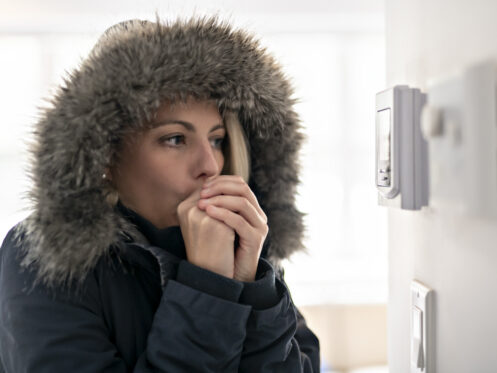
Heat pumps are becoming an increasingly popular HVAC system for residential homeowners. They’re great for providing adequate warmth during the winter and air conditioning during the summer. Unfortunately, your heat pump may blow cold air while it’s in heating mode for several different reasons. Understanding what these reasons are can help you make a better-informed decision about what to do next.
1. Defrost Mode
By far the most obvious reason that your heat pump will blow cold air even when it’s on heating is that it’s in defrost mode. During the colder winter season, frost can accumulate on the outdoor coils inside your condenser unit. When this happens, your system will temporarily switch into cooling mode to force heat out to the coils to melt the ice. This is necessary to prevent a large amount of ice from building up on the coils that could otherwise interfere with the functioning of your heat pump.
While your unit is in defrost mode, you may feel cold air temporarily coming out of your air vents or air handler units. This can last for several minutes while your system goes through its defrost cycle. Eventually, your heat pump will switch back to heat mode, and you’ll feel warm air coming out of your vents. As long as your heat pump switches back to warming your home within 15 minutes, there’s nothing wrong with it.
2. Wrong Fan Setting
Another problem that you may experience is that you have your blower fan on the wrong setting. Whenever you have your blower fan set to ON, it will run 24/7. This means that even when your heat pump isn’t technically running to warm your home, the fan is still circulating the air in your home. The air will feel colder than what you’re used to feeling when warm air is coming out of the vents.
It’s important to check your thermostat to see what blower fan setting you have it on. If your blower fan is set to ON, you want to switch it over to AUTO. When your blower fan is set to AUTO, it only runs the blower fan when your heat pump is actually working. This means that it’s only circulating air when your heat pump is producing heat.
3. Low Refrigerant Level
The lifeblood of any effective heat pump is refrigerant. It’s responsible for transferring heat from one location to another during the winter months. Refrigerant is responsible for absorbing heat from outside and bringing it into your home. Unfortunately, if the refrigerant level in your system is low, it can reduce the heating efficiency of your unit.
Refrigerant levels can become low due to a leak in your system. This can cause it to blow lukewarm or cold air instead of warm air. When you have a low refrigerant level, it leads to a slew of other issues, like icing on the outdoor coil, longer runtimes, and higher energy bills. If you suspect that you have a low refrigerant problem, it’s important to contact a professional to identify the source of the leak and repair it. You’ll also need to recharge your refrigerant level to restore functionality to your heat pump.
4. Dirty Air Filter
One lesser-known culprit behind cold air coming out of your vent is a dirty air filter. For your heat pump to operate efficiently, it needs to have adequate airflow throughout your ducting. If the air filter gets clogged full of debris, it will act more like a wall that restricts airflow throughout your ducting. This can cause your heat pump to overheat and trigger its safety switch to shut it off.
It can be helpful when you first experience cold air to check your air filter. You can do this by pulling it out of its housing and holding it up to a light. If you can’t see through the filter, it needs to be replaced with a new one. Ensure that you put in an appropriately sized filter to meet the specifications of your unique HVAC system.
5. Blocked Outdoor Unit
Just like a dirty air filter can restrict airflow through your ducting, debris can do the same thing at your outdoor condenser unit. Anytime that debris like ice, snow, or even leaves blows up against the outside of your unit, it can affect its functioning. It does this by restricting the flow of air through the unit, making it harder for heat to reach the refrigerant-filled coils.
This is an easy fix, as all you need to do is remove any debris that’s up against your outdoor unit. It’s a good rule of thumb to ensure that there’s at least two feet of clearance around the entire unit for adequate airflow. This means trimming back any shrubbery or low-hanging branches that could be restricting airflow around your unit.
6. Thermostat Malfunction
Another potential cause of cold air coming from your heat pump during the winter is a malfunctioning thermostat. If your thermostat isn’t reading the appropriate indoor temperature, it could be sending an incorrect signal to your heat pump to cool your home instead of heating it. Issues like loose wiring, dying batteries, incorrect calibration, and even outdated thermostats can all contribute to these performance issues. It’s best to have a professional fully evaluate your thermostat and perform the necessary alterations to restore adequate functionality.
7. Reversing Valve Issue
One underlying cause of cold air coming out of your heat pump during the winter is a bad reversing valve. The reversing valve is responsible for changing the flow of refrigerant through your system. During the summer, refrigerant flows from inside to absorb heat and takes it to the outside unit. During the wintertime, your refrigerant flows from the outdoor unit to the indoor unit.
If your unit was recently cooling your home and is now trying to switch over to heating, you may have a faulty reversing valve that is keeping it in cooling mode. It’s important to have a professional perform the diagnostic to determine if you have a reversing valve problem and to repair it. It’s a complex component that requires extra care to thoroughly assess.
8. Extremely Cold Temperatures
One reason you may be experiencing cold air is that the outside air is extremely cold. Standard heat pumps are very efficient when there are moderate winter temperatures. Whenever the outside temperature drops below freezing, it can hinder your unit’s ability to adequately extract enough heat from the air. This can have it blowing lukewarm or even cold air instead of nice and warm air.
In a cold climate like Denver, it’s important to always purchase a cold-weather heat pump. This is a specialized type of heat pump that can perform efficiently in temperatures down to around -20 degrees Fahrenheit. If you have a standard heat pump, you may want to consider upgrading it to a cold-climate heat pump to ensure optimal heating performance throughout the entire winter season.
Reliable Heat Pump Repair Service
Summit Heating, A/C, Plumbing & Electrical provides reliable heat pump repair service for Denver, CO, and the surrounding communities. We can also assist with all your heat pump installation, replacement, and repair needs. Contact our office today to schedule your next service consultation.