
When you turn on the AC in your Denver, CO, home, you expect plenty of cold air to rush from your vents. When you get weak airflow instead, it’s easy to panic. Before you do, you should know that there are several potential causes for this issue. It can help if you understand what may be going on so that you can relay accurate information to a repair technician from our team.
A Dirty Air Filter
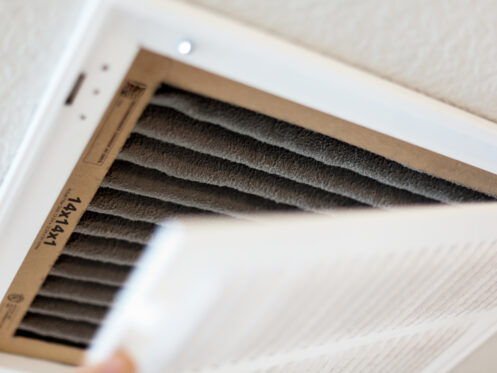
Your HVAC system has an air filter that requires periodic replacement. In most cases, they need replacement every 30 to 90 days. If you fail to change your AC air filter regularly, you may experience airflow problems.
Your HVAC air filter sits between the return air ducts and the blower motor. Its job is to capture dust and dirt circulating in your home’s air. This keeps the AC blower motor and evaporator coil as clean as possible. However, that means your air filter grows increasingly dirty with time. Eventually, the filter will become so clogged that air will struggle to pass through it. That results in weak AC airflow.
If you handle air filter changes yourself, be especially careful to choose the right replacement filter. You should always select a filter with the proper MERV rating for your system. Higher MERV ratings mean better filtration, but they also mean reduced airflow. If you’ve upgraded to a higher-MERV filter than your AC calls for, it could be the cause of your problem. Ideally, residential HVAC systems benefit from a filter with a MERV rating between 8 and 12. If you’re not sure if you have the right filter, give us a call. We can let you know the proper specifications, and we likely carry the proper replacement filter. If you’re worried about indoor air quality, we offer purpose-built filtration options that won’t interfere with your AC’s airflow. They include whole-house air purifiers and UV light air sterilization systems.
A Frozen Evaporator Coil
Another potential cause of weak AC airflow is a frozen evaporator coil. Your AC evaporator coil is inside your AC’s indoor air handler. The AC sends cold liquid refrigerant through the evaporator while the blower fan pushes air across it. As the hot air from your home passes by, the liquid refrigerant absorbs heat from it until it boils into a vapor. That is how an AC produces cold air. After boiling, the refrigerant travels outside to expel the collected heat into the outdoors. Because of the cooling process, moisture from your home’s warm air condenses on the cold evaporator coil. In certain circumstances, the condensate may freeze, which blocks airflow.
There are signs that help you spot a frozen evaporator coil. Start by checking your AC condensate drain line. You should see a steady drip coming from it while your AC runs. If you don’t, examine the exterior of your AC’s indoor unit for signs of leaks. If you can’t see any, odds are good that you have a frozen evaporator coil.
Don’t ignore signs of a frozen evaporator coil. One common cause of this problem is refrigerant leaks. Low refrigerant pressure causes your evaporator temperature to drop. If you keep running your AC in this condition, it can eventually suffer a compressor failure. That is a costly AC repair that may even force a total replacement. Your AC may also experience a premature blower motor failure due to excessive backpressure and overheating.
Ductwork Problems
Issues with your home’s HVAC ductwork can also lead to weak AC airflow. One potential cause is an obstructed return air grille. The return air grille is a centrally located duct opening that lets your AC draw in warm air from around your home. If anything gets in the way of it, your AC’s overall airflow drops.
Closing too many AC supply vents can result in reduced airflow. An increase in static pressure in the air ducts can occur. This is a force that pushes back against your AC blower while it runs. That alone can lower airflow coming from the remaining vents. It will also increase wear and tear on your AC blower motor. Additionally, closing vents reduces the air supply available to the AC return air ducts.
Damage to your home’s HVAC ductwork can also lead to weak AC airflow. For example, if a duct seam ruptures or a duct section disconnects, that can cause it. In those situations, conditioned air may escape into your home’s walls. That reduces the remaining airflow that reaches your home vents. If you’re noticing weak airflow from some vents but not all, damaged ductwork is a likely cause.
It is also possible that a ductwork damper has slipped out of position. Dampers control the air volume passing through each branch of your ductwork. If any are in a partially closed position, it will reduce air flow to part of your home’s vents. If your HVAC has a zoning system, a malfunction there can also cause airflow issues. Zoning systems use motorized duct dampers to control airflow. If one fails, it may get stuck fully or partially closed, cutting off airflow to its duct.
A Faulty Blower Motor
A problem with your AC blower motor may lead to reduced airflow from your vents. However, it rarely happens without some other noticeable symptoms. For example, a failing blower motor may squeal or vibrate, which you will hear if you stand near your AC indoor unit. You may also notice an unusual increase in your household energy costs. However, certain kinds of blower motor failure modes are harder to spot.
If your AC features a two-speed or variable-speed blower motor, it can fail in hard-to-detect ways. This is because such motors can operate at reduced speeds even when working normally. If the motor malfunctions, it could get stuck in low-speed mode, which causes weak airflow. Or your AC control circuitry may fail to send the right signal to the blower motor. If the system never tells the blower to speed up, you will get stuck with perpetually weak airflow. In any event, you should always call for a service appointment if you suspect a blower motor problem.
Solving Your AC Airflow Problems
Whenever your AC is not blowing a sufficient amount of cool air, Summit Heating, A/C, Plumbing & Electrical can help. We have served Denver homeowners with pride since 1998. We service ACs of all makes and models. Our services include emergency HVAC repair when needed. We also offer a Friends and Family Club membership to help meet your HVAC maintenance needs. Regular HVAC maintenance is the best way to prevent unexpected trouble. We encourage you to read some of our customer reviews on our website to see what your neighbors think of our work. When you have an AC airflow issue in Denver, contact Summit Heating, A/C, Plumbing & Electrical right away.